
You are using an out of date browser. It may not display this or other websites correctly.
You should upgrade or use an alternative browser.
You should upgrade or use an alternative browser.
Telescope to attach Z7 to
- Thread starter Lisa Zee
- Start date

BF Hammer
Senior Member
Lisa, I wish there could be a simple answer for such a simple question. I do not own a telescope, but I have done some of the research. I simply use my Nikkor 70-200mm f/2.8 and Sigma 150-600mm C to do my DSO work (Deep Space Object).
In a generic explanation, you need a T-adapter for Z-mount. T-adapter meaning telescope, and it would install in place of an eyepiece. A telescope that can be fitted with different magnification eyepieces is what you would look for there.
As for a starter telescope, I keep seeing recommendations for a refractor style in the range of 450-600mm size. A refractor is the kind with glass lenses in a line that you look through from the back end, very much like your camera lenses. On the cheaper end are doublets with 2 elements, but most recommend trying to get at least a triplet telescope. Often in front of the T-adapter there might be a field-flattener to buy which make the distorted stars in the corners appear more round.
And none of this addresses what may be the most important part: Tripod and mount. You need a sturdy enough base to hold everything without transmitting vibration to the camera, and a motorized tracking mount that can bear the weight of everything. That tracking mount is not really an option either with astrophotography. The more you zoom in, the shorter the.j exposure time must be to avoid motion blurs. You will certainly need to attempt 45 second to 90 second exposures on the low end and still have to do exposure stacking to gain and hour or more of total exposure. The mount has to track accurately to give you that.
So as I said, I use camera lenses, not a telescope. But I do have a motorized telescope mount with Go-To control. That means once I carefully align it to a pole (using Polaris in the north in my case) I can use a phone app to select a target and aim the camera. My mount has about 5Kg load and I also use counterweights to steady it some more. I have had some nights where I managed to set-up and align perfectly and it tracked right to any target I requested, and I have had more where I had things a little off. When it is right, photos can be beautiful.
I actually took these photos with the Sigma 150-600mm. They are exposure stacked, but that is pretty standard for DSO photos.


In a generic explanation, you need a T-adapter for Z-mount. T-adapter meaning telescope, and it would install in place of an eyepiece. A telescope that can be fitted with different magnification eyepieces is what you would look for there.
As for a starter telescope, I keep seeing recommendations for a refractor style in the range of 450-600mm size. A refractor is the kind with glass lenses in a line that you look through from the back end, very much like your camera lenses. On the cheaper end are doublets with 2 elements, but most recommend trying to get at least a triplet telescope. Often in front of the T-adapter there might be a field-flattener to buy which make the distorted stars in the corners appear more round.
And none of this addresses what may be the most important part: Tripod and mount. You need a sturdy enough base to hold everything without transmitting vibration to the camera, and a motorized tracking mount that can bear the weight of everything. That tracking mount is not really an option either with astrophotography. The more you zoom in, the shorter the.j exposure time must be to avoid motion blurs. You will certainly need to attempt 45 second to 90 second exposures on the low end and still have to do exposure stacking to gain and hour or more of total exposure. The mount has to track accurately to give you that.
So as I said, I use camera lenses, not a telescope. But I do have a motorized telescope mount with Go-To control. That means once I carefully align it to a pole (using Polaris in the north in my case) I can use a phone app to select a target and aim the camera. My mount has about 5Kg load and I also use counterweights to steady it some more. I have had some nights where I managed to set-up and align perfectly and it tracked right to any target I requested, and I have had more where I had things a little off. When it is right, photos can be beautiful.
I actually took these photos with the Sigma 150-600mm. They are exposure stacked, but that is pretty standard for DSO photos.

Lisa Zee
New member
Great photos!. I've been reading a lot about astrophotography on Reddit and other forums. It can easily get confusing and expensive.
I have considered two options after doing a lot of research:
Option 1: Sky-Watcher Star Adventurer 2i Pro Kit
Option 2: Telescope with Mount
I know many will say start with option 1 and then down the track go with option 2 but I don't want to buy option 1 only to realise I could get better photos with option 2. Both are considered entry level/beginner set ups from what I have read. I'd also need to buy a tripod with option 1.
I watched a video on Astro Backyard of a guy that shows you how to take photos of Andromeda Galaxy with just a camera and tripod. But this involves using a Bhatinov mask (which I did actually buy), then taking calibration frames, biosframes, flat frames and light frames (literally around 1000 shots). Then using Deep Sky Stacker to pre-process (which takes about 22 hours), and of course Photoshop or similar for final processing.
Is there an easier way? Would less frames need to be taken if using a telescope with camera attached? Or would the pre-processing be pretty much the same?
Thanks for the input so far, as there is just so much information out there I've been down a rabbit hole
I have considered two options after doing a lot of research:
Option 1: Sky-Watcher Star Adventurer 2i Pro Kit
Option 2: Telescope with Mount
I know many will say start with option 1 and then down the track go with option 2 but I don't want to buy option 1 only to realise I could get better photos with option 2. Both are considered entry level/beginner set ups from what I have read. I'd also need to buy a tripod with option 1.
I watched a video on Astro Backyard of a guy that shows you how to take photos of Andromeda Galaxy with just a camera and tripod. But this involves using a Bhatinov mask (which I did actually buy), then taking calibration frames, biosframes, flat frames and light frames (literally around 1000 shots). Then using Deep Sky Stacker to pre-process (which takes about 22 hours), and of course Photoshop or similar for final processing.
Is there an easier way? Would less frames need to be taken if using a telescope with camera attached? Or would the pre-processing be pretty much the same?
Thanks for the input so far, as there is just so much information out there I've been down a rabbit hole
BF Hammer
Senior Member
I used to watch Trevor's (astro backyard) videos regularly. In the early years he was using more basic gear but he leveled-up a lot over the years. I will politely say Trevor gets pretty geeky in his processing and I do a lot less. No darks or flats, I use Siril to stack and process mostly and do the finishing in GIMP.
Some other YouTube inspiration for me has been Nico Carver and The Lazy Geek. Nico does get lost in covering every detail often, but you pick up a lot of his hard-earned experience. Cuiv (Lazy Geek) lives in Tokyo and still makes good images through all that light pollution. He emphasizes affordable gear and free software and techniques.
But I won't be able to guide you on this topic much further than this as I have not taken the steps into buying a telescope. Yet.
Some other YouTube inspiration for me has been Nico Carver and The Lazy Geek. Nico does get lost in covering every detail often, but you pick up a lot of his hard-earned experience. Cuiv (Lazy Geek) lives in Tokyo and still makes good images through all that light pollution. He emphasizes affordable gear and free software and techniques.
But I won't be able to guide you on this topic much further than this as I have not taken the steps into buying a telescope. Yet.

Burt
New member
Old thread, but something I have been experimenting lately...
I was going to start a new thread, but I will take advantage of this one instead...
I was able to use my Nikon Zfc With the 16-50 lens attached to the Vanguard Endeavor HD 82A 20–60x82 Angled Spotting Scope by using the PA-202 adapter (it can take any lens size). The idea was to take pictures of the sky at night...
It was a failure.. The Vanguard is not the best quality for lenses particularly in low light situations, and I believe most telescope would have the same light issue.. In my humble opinion, and I think I'm stating the obvious here, you really need quality lenses for this kind of photography..
The HD 82A works ok at bird spotting during the day, but that is pretty much it... What I have learn however was that I can use it in the day for magnify pictures taken at great distance (50 is the max before the picture start do degrade, but that's a limitation of the HD 82A.. I had some sample pictures, but I just delete them yesterday as they had no real use..
Now the second part of my post is that, I did a search on this forum, and I wasn't able to find a thread related to Astrophotography, other than a few related comments...
I wouldn't mind learning the ropes about Astrophotography, as I'm in a country with very little light pollution and most of the time, a clear 360° view of the sky...
So if we don't already have it, and I wasn't able to find it, would it be possible to start a new forum under the general photography, if there is enough interest here that is, just relate to Astrophotography...
Cheers...
I was going to start a new thread, but I will take advantage of this one instead...
I was able to use my Nikon Zfc With the 16-50 lens attached to the Vanguard Endeavor HD 82A 20–60x82 Angled Spotting Scope by using the PA-202 adapter (it can take any lens size). The idea was to take pictures of the sky at night...
It was a failure.. The Vanguard is not the best quality for lenses particularly in low light situations, and I believe most telescope would have the same light issue.. In my humble opinion, and I think I'm stating the obvious here, you really need quality lenses for this kind of photography..
The HD 82A works ok at bird spotting during the day, but that is pretty much it... What I have learn however was that I can use it in the day for magnify pictures taken at great distance (50 is the max before the picture start do degrade, but that's a limitation of the HD 82A.. I had some sample pictures, but I just delete them yesterday as they had no real use..
Now the second part of my post is that, I did a search on this forum, and I wasn't able to find a thread related to Astrophotography, other than a few related comments...
I wouldn't mind learning the ropes about Astrophotography, as I'm in a country with very little light pollution and most of the time, a clear 360° view of the sky...
So if we don't already have it, and I wasn't able to find it, would it be possible to start a new forum under the general photography, if there is enough interest here that is, just relate to Astrophotography...
Cheers...
BF Hammer
Senior Member
Sometimes people try holding a phone to a telescope eyepiece, but it doesn't work well due to contrast issues and motion blur.Old thread, but something I have been experimenting lately...
I was going to start a new thread, but I will take advantage of this one instead...
I was able to use my Nikon Zfc With the 16-50 lens attached to the Vanguard Endeavor HD 82A 20–60x82 Angled Spotting Scope by using the PA-202 adapter (it can take any lens size). The idea was to take pictures of the sky at night...
It was a failure.. The Vanguard is not the best quality for lenses particularly in low light situations, and I believe most telescope would have the same light issue.. In my humble opinion, and I think I'm stating the obvious here, you really need quality lenses for this kind of photography..
The HD 82A works ok at bird spotting during the day, but that is pretty much it... What I have learn however was that I can use it in the day for magnify pictures taken at great distance (50 is the max before the picture start do degrade, but that's a limitation of the HD 82A.. I had some sample pictures, but I just delete them yesterday as they had no real use..
Now the second part of my post is that, I did a search on this forum, and I wasn't able to find a thread related to Astrophotography, other than a few related comments...
I wouldn't mind learning the ropes about Astrophotography, as I'm in a country with very little light pollution and most of the time, a clear 360° view of the sky...
So if we don't already have it, and I wasn't able to find it, would it be possible to start a new forum under the general photography, if there is enough interest here that is, just relate to Astrophotography...
Cheers...
This is a rapidly changing field of photography. Posts from 3 years ago can be completely out of date now. The most basic wide-field night landscape works the same but deep-sky objects (DSO) is being done so differently as technology and software changes. Right now for the price of a quality telephoto lens you can buy a smart telescope with the camera built in. It is controlled by a phone app, tracks and collects image data for hours to build your photo. Set up in a couple of minutes and pack away compact. This is the new thing. Look up Seestar, and that is just one of many now.
Kind of makes buying a travel telescope, tracking mount, T-adapter and camera feel like a futile exercise. Then the hours of tending to the rig, processing the images in dedicated astrophotography software to get your result.
Burt
New member
I have to admit that what you are saying, it does make a lot of sense, especially financially..Sometimes people try holding a phone to a telescope eyepiece, but it doesn't work well due to contrast issues and motion blur.
This is a rapidly changing field of photography. Posts from 3 years ago can be completely out of date now. The most basic wide-field night landscape works the same but deep-sky objects (DSO) is being done so differently as technology and software changes. Right now for the price of a quality telephoto lens you can buy a smart telescope with the camera built in. It is controlled by a phone app, tracks and collects image data for hours to build your photo. Set up in a couple of minutes and pack away compact. This is the new thing. Look up Seestar, and that is just one of many now.
Kind of makes buying a travel telescope, tracking mount, T-adapter and camera feel like a futile exercise. Then the hours of tending to the rig, processing the images in dedicated astrophotography software to get your result.
I did try at first with the phone mount attached to the spotter, but that failed miserably as well.. Even the moon moves too fast when you have 20 things to adjust before you take the shot...
Ok... subject closed then... The next full moon I will give it the last try using the scope and the Zfc.. If that doesn't work either, then I'm done...
PS
I just checked the Seestar S30 Pro... It cost less, much less than a good lens...
Last edited:
BF Hammer
Senior Member
Minimum equipment for moon is tripod, telephoto lens of 300mm for DX body, but more is better. Much better to photograph the moon at the quarter phase or as a crescent, since the light won't blow out the detail as much, and you get shadow along the terminator for additional detail.
A single exposure image is very doable. But set the self timer on the Zfc to shoot 30-60 exposures a little under-exposed, then use astrophotography stacking software to align and combine the exposure data for far more detail. And it blends out ISO noise.
The moon will move across the individual frames, but the stacking software is supposed to deal with that for you. For dimmer deep-sky objects such as galaxies and nebulae, you almost need to invest in powered tracking equatorial mount. When the polar alignment is correct, you can take 60 second or sometimes longer exposures. Of course this also would lead to stacking 100+ exposures to get those pretty images of space clouds. This works even better when you tether a laptop to the camera and control the exposure settings and sequence remotely.
This is why I say it can just make more sense to buy a smart telescope today. Less money, less work. But the moon and Milky Way landscapes are fairly easily done without the extra gear, even if stacking software would become involved.
Siril is the free astro software of choice right now.
PS: It understand polar aligning to the Southern Cross gets fairly tricky compared to us in the north having Polaris to align to.
A single exposure image is very doable. But set the self timer on the Zfc to shoot 30-60 exposures a little under-exposed, then use astrophotography stacking software to align and combine the exposure data for far more detail. And it blends out ISO noise.
The moon will move across the individual frames, but the stacking software is supposed to deal with that for you. For dimmer deep-sky objects such as galaxies and nebulae, you almost need to invest in powered tracking equatorial mount. When the polar alignment is correct, you can take 60 second or sometimes longer exposures. Of course this also would lead to stacking 100+ exposures to get those pretty images of space clouds. This works even better when you tether a laptop to the camera and control the exposure settings and sequence remotely.
This is why I say it can just make more sense to buy a smart telescope today. Less money, less work. But the moon and Milky Way landscapes are fairly easily done without the extra gear, even if stacking software would become involved.
Siril is the free astro software of choice right now.
PS: It understand polar aligning to the Southern Cross gets fairly tricky compared to us in the north having Polaris to align to.

Clovishound
Senior Member
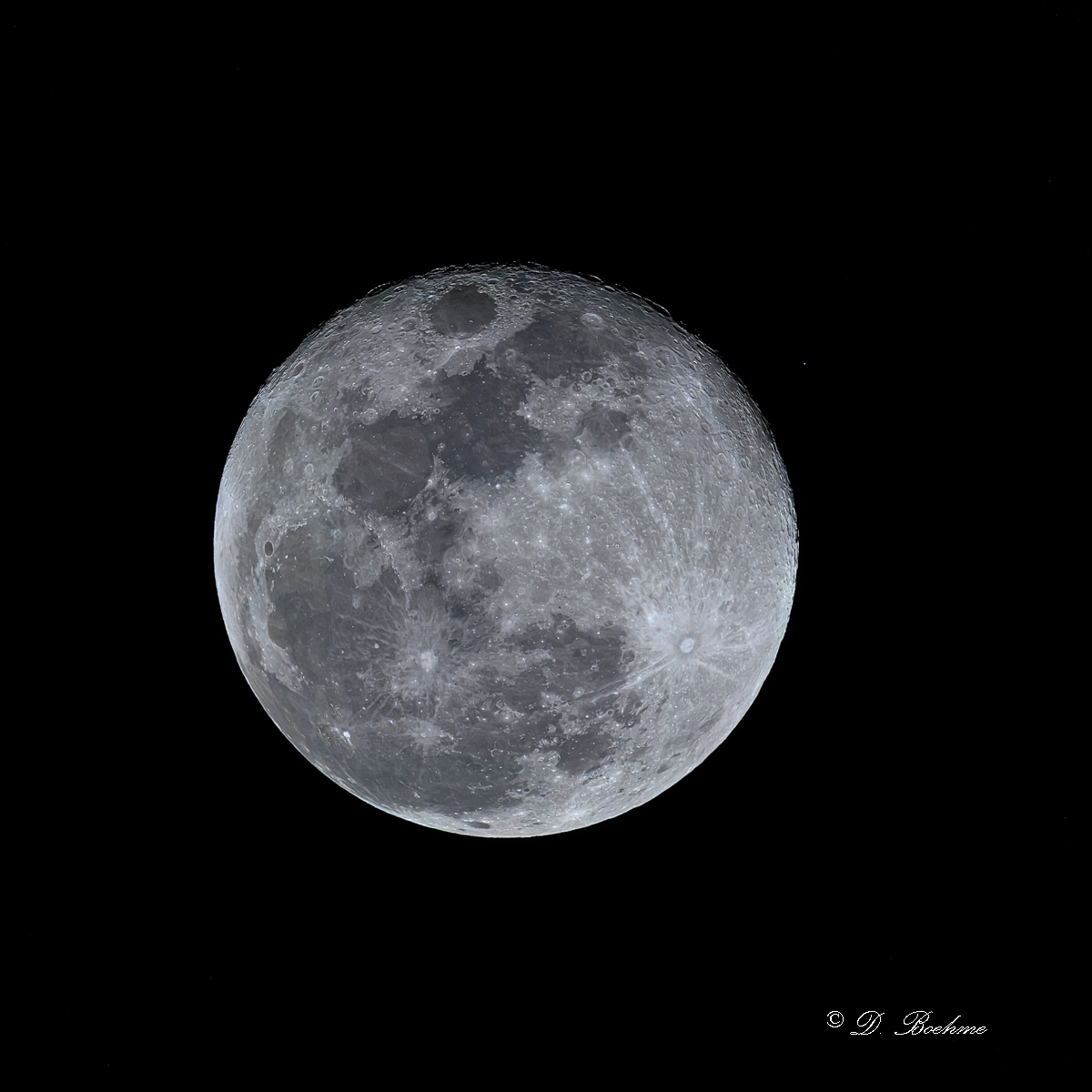
Here's a shot of the moon using my 180-600 at 600mm on a full frame sensor.

Clovishound
Senior Member
Try it with a tripod, and pay close attention to your focus, although I suspect camera movement is your main culprit here. With a tripod and proper shutter etiquette, you can lower your ISO to 100, or even 64, which will help slightly in resolution. You are working with a 46 MP sensor, so you can crop tighter than a standard rez sensor. The good news is that the moon is well lit, basically full sun. This makes life easier to get sharp images. Shooting on really clear nights helps as well.This is what I got without any editing, other than cropping and with no tripod... So I think there is room for improvements... But I would like to get even closer than 600, but not with the price of the 800 lens
View attachment 428439